
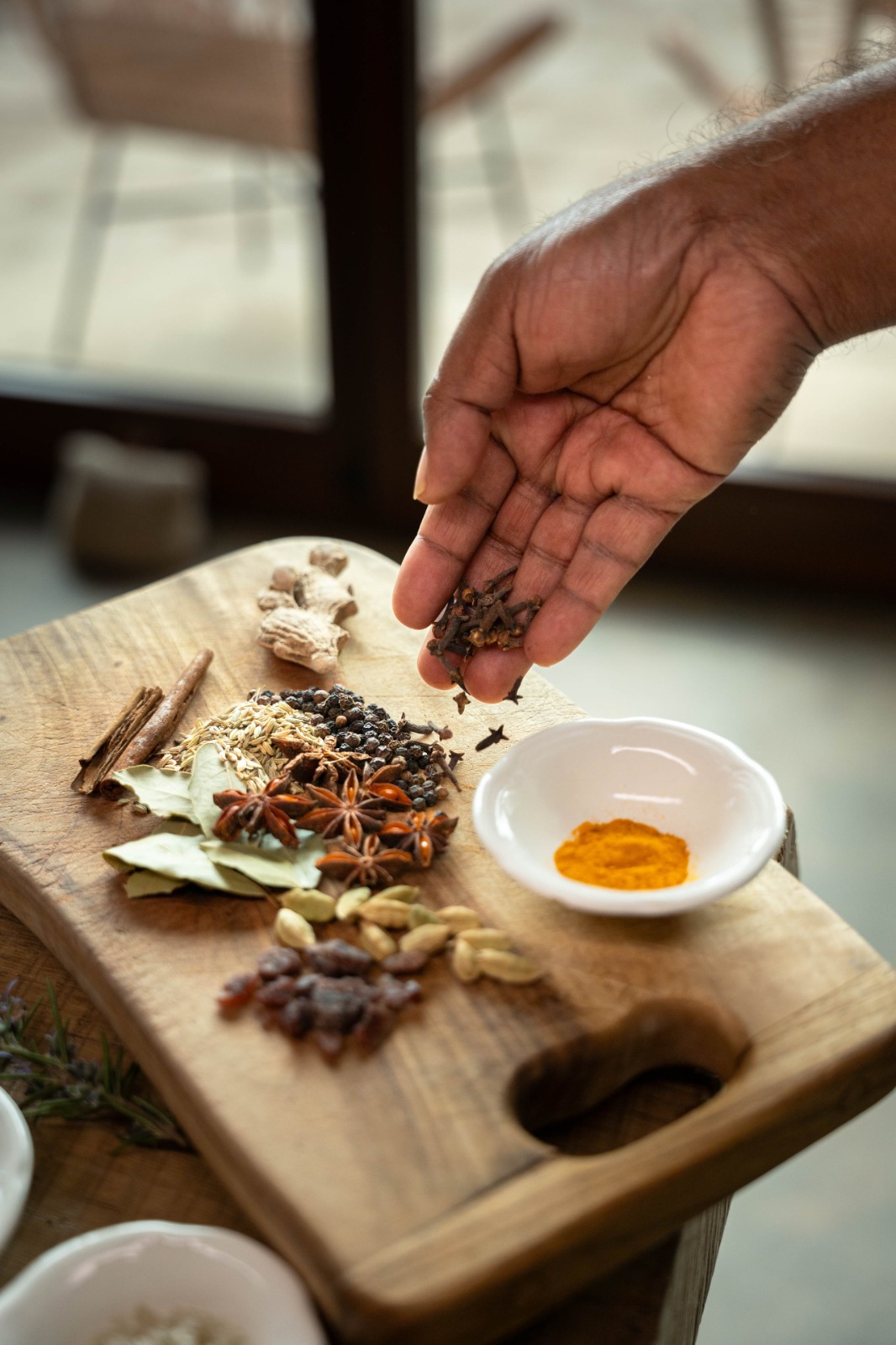
Ayurveda without compromise
When people think of Ayurveda, they often think of treatments, herbal remedies, therapeutic oils and nutrition. Yet authentic Ayurveda begins long before the first treatment is given or the first herbal preparation is prescribed.
Traditional Ayurveda Begins with Knowledge
It begins with a deep understanding of the principles and philosophy behind this ancient tradition.
For us, this means working with an Ayurvedic Doctor who has completed the Bachelor of Ayurvedic Medicine and Surgery (BAMS) programme in India, but whose knowledge extends beyond formal education. Someone who has devoted years to studying classical texts such as the Charaka Samhita, learning from experienced teachers and understanding the wisdom passed down through generations.
Someone who recognises that Ayurveda is not simply a system of healthcare, but a way of understanding life itself.
At Its Heart, Ayurveda Is Deeply Connected to Nature
Ayurveda encourages us to understand the seasons, climate, soil, plants, animals and natural cycles that shape our environment. It teaches us to observe the relationship between nature and the human body, and the importance of maintaining balance.
This connection with nature also brings an important responsibility: paying close attention to the quality and origin of every ingredient used in traditional Ayurvedic preparations.
Where was the plant grown? When was it harvested? Was it collected in a clean environment, away from busy roads and industrial areas? Was it processed correctly? Were the ingredients and preparation methods faithful to the traditional formulation?
These questions may seem simple, but they are fundamental to the quality, consistency and integrity of an Ayurvedic product.
One Question Kept Returning to Us at Torres de Selma
How can we offer authentic Ayurveda if we cannot be confident in the quality of the products we use?
This question became the starting point of an intensive search that lasted more than a year.
We spoke with suppliers, explored different production methods and learned more about the realities of the Ayurvedic market.
What we discovered was not always encouraging.
In some cases, traditional formulations had been modified, ingredients substituted or production methods adapted to reduce costs and increase efficiency. Certain fermentation processes had been accelerated, while preservatives were used to extend shelf life.
Of course, large-scale production does not automatically mean poor quality. However, we wanted to find producers whose approach placed traditional preparation methods, ingredient selection and careful production at the centre of everything they did.
For us, authenticity had to be more than a label.
Then, Almost Unexpectedly, We Found What We Had Been Looking For
We met an Ayurvedic Doctor whose commitment to quality closely reflected our own vision of Ayurveda.
His journey began with a simple ambition: to practise Ayurveda in Europe while maintaining the standards and traditions he considered essential.
For him, preserving the integrity of traditional preparations was not a secondary consideration. It was fundamental to his approach.
Working with a carefully selected network of Ayurvedic pharmacies and small production units in Kerala and Tamil Nadu, he chose to focus on ingredient quality, traditional formulations and carefully supervised preparation methods.
Herbs are sourced from trusted suppliers, ingredients are selected with care and production methods are guided by classical Ayurvedic principles.
Many of the herbal powders and medicated oils are still produced in small batches, often made to order.
Not because this is the easiest or most economical approach, but because it allows greater attention to be given to each stage of production.
The same philosophy applies to traditional Ayurvedic fermented preparations, including Arishtam and Asavam. Rather than prioritising speed, the producers we work with favour fermentation methods rooted in traditional Ayurvedic practice.
These choices reflect something we deeply value at Torres de Selma: taking the time to do things properly.
Medicated Ghee: A Traditional Preparation with Particular Care
One example that particularly impressed us was the approach to medicated ghee, traditionally known as Ghritam.
The ghee used in these preparations is sourced from milk produced by the Vechur cow, a small indigenous cattle breed from Kerala.
Vechur cattle are valued for their place in Kerala’s agricultural heritage and for the distinctive characteristics of their milk.
The milk is used to prepare ghee, which then forms the basis of traditional Ayurvedic formulations containing carefully selected herbs.
What matters to us is not simply the origin of the milk, but the attention given to the entire preparation process: from sourcing the ingredients to following the traditional methods used to produce medicated ghee.
This dedication to detail reflects the philosophy we were searching for.
Kashayam: The Art of the Traditional Herbal Decoction
Another important example is Kashayam, a traditional Ayurvedic herbal decoction.
A decoction is prepared by simmering a carefully selected combination of herbs, roots, bark, leaves or spices in water until the liquid is reduced and concentrated.
Unlike a simple herbal infusion, in which ingredients are steeped in hot water, a decoction generally involves a longer preparation process. This is particularly useful when working with tougher plant materials such as roots and bark.
The process allows water-soluble constituents to be extracted from the plants, creating a concentrated herbal preparation.
Kashayam has an important place in classical Ayurveda, where the selection of herbs, their proportions and the method of preparation are considered essential.
Why We Prefer Freshly Prepared Decoctions
Commercially produced Kashayams are often supplied as ready-to-use liquids in bottles. Depending on the manufacturer and formulation, these products may contain preservatives or undergo processing to extend their shelf life.
Although bottled preparations can offer convenience, our preference is to remain as close as possible to the traditional method of preparing a fresh decoction.
For this reason, our Ayurvedic partner works with finely powdered herbal formulations, known as Kashaya Sookshma Churnam (KSC).
These preparations allow a decoction to be made using the prescribed quantity of herbs and water, following the instructions provided by the Ayurvedic Doctor.
For guests and patients who find it difficult to prepare a decoction at home or at work, tablet formulations may be offered as a practical alternative.
Our preference for freshly prepared Kashayam reflects our commitment to traditional Ayurvedic practice. It does not mean that every freshly prepared decoction is necessarily more effective than every commercially manufactured alternative; quality and suitability depend on the formulation, preparation and individual circumstances.
At Torres de Selma, this thoughtful approach to ingredients and preparation resonates deeply with our own values.
Ayurveda Is Not About Shortcuts
Ayurveda is not about convenience or producing remedies as cheaply or quickly as possible. It is about honouring a tradition that has been passed down through thousands of years, rooted in a profound understanding of nature, health and balance. Every oil used during a treatment, every carefully selected herb, the ghee prepared according to traditional methods and the remedies prescribed by the Ayurvedic Doctor are all part of the same philosophy. One that begins with respect: respect for the plants, for the time and care involved in their preparation, for the ancient knowledge passed down through generations and, above all, for the individual receiving the treatment. Because authentic Ayurveda is not simply about the ingredients we use, but about the knowledge, integrity and intention behind every step.
This philosophy also guides the personalised approach to treatments in our 12-day Panchakarma retreat.
This is what we mean by Ayurveda without compromise.
Frequently Asked Questions: Ayurveda Without Compromise
What do you mean by “Ayurveda Without Compromise”?
For us, Ayurveda Without Compromise means remaining as faithful as possible to the principles and traditional practices of authentic Ayurveda.
This commitment extends beyond consultations and treatments to the quality of the herbs, oils, medicated ghee and other Ayurvedic preparations we use.
From sourcing ingredients to selecting production methods, we believe every step deserves care, knowledge and respect for the original tradition.
Why is product quality so important in Ayurveda?
Traditional Ayurveda places great importance on the properties, origin and preparation of natural ingredients.
Where a plant is grown, when it is harvested, how it is stored and processed, and whether the formulation is prepared correctly can all influence the quality and consistency of the final product.
For us, careful sourcing and preparation are essential parts of responsible Ayurvedic practice.
How do you select your Ayurvedic products?
We spent more than a year researching suppliers, exploring production methods and learning about ingredient sourcing before finding partners whose approach reflected our own values.
Today, we work with an Ayurvedic Doctor and a carefully selected network of pharmacies and small production units in Kerala and Tamil Nadu, India.
We prioritise traditional formulations, carefully sourced ingredients and production methods that allow close attention to quality.
Why do you prefer working with smaller producers?
We value the personal attention, flexibility and close involvement in production that smaller producers can offer.
Many of the preparations we use are made in small batches, sometimes specifically to order.
This approach allows the producers to focus on traditional preparation methods and maintain oversight of the process.
We recognise that high-quality Ayurvedic products can also be produced on a larger scale. Our choice is based on the methods and values of the particular producers we work with, rather than their size alone.
Are your herbal oils and powders produced in small batches?
Yes. Many of the herbal powders, traditionally known as Churnam, and medicated oils, known as Thailam, are produced in small batches and often made to order.
This allows careful attention to ingredient selection, preparation and production.
Why is traditional fermentation important?
Certain classical Ayurvedic preparations, including Arishtam and Asavam, are produced through fermentation.
Fermentation is an integral part of these traditional formulations, influencing their composition and characteristics.
Our partners favour methods based on classical Ayurvedic practice, with careful attention to the ingredients, fermentation process and final preparation.
What makes your medicated ghee special?
The medicated ghee, known as Ghritam, is prepared using ghee sourced from milk produced by the Vechur cow, a small indigenous breed from Kerala.
The ghee is then used as a base for traditional herbal formulations.
We particularly value the attention given to ingredient sourcing and preparation, as well as the respect shown for traditional Ayurvedic methods.
What is Kashayam?
Kashayam is a traditional Ayurvedic herbal decoction.
It is prepared by simmering selected plant ingredients, such as herbs, roots, bark, leaves and spices, in water until the liquid is reduced and concentrated.
The ingredients and method of preparation depend on the particular formulation prescribed by the Ayurvedic Doctor.
What is a decoction?
A decoction is a method of preparing a concentrated herbal liquid by simmering plant materials in water.
Unlike a herbal tea or infusion, which is usually prepared by steeping ingredients in hot water, a decoction generally requires a longer simmering process.
This method is particularly suitable for extracting water-soluble constituents from tougher plant materials such as roots, bark and seeds.
Why do you prefer not to use bottled Kashayams?
Some commercially bottled Kashayams contain preservatives or undergo processing to extend their shelf life.
Our preference is to use preparations that allow the decoction to be made fresh, following traditional Ayurvedic methods.
This choice reflects our philosophy of staying close to classical preparation practices rather than a claim that all bottled products are inferior.
How do you provide Kashayam?
We use Kashaya Sookshma Churnam (KSC), a finely powdered herbal formulation that can be prepared as a fresh decoction according to the Ayurvedic Doctor’s instructions.
For those who cannot easily prepare a decoction at home or at work, tablet formulations may be available as a practical alternative.
Are tablets as effective as a freshly prepared decoction?
In traditional Ayurvedic practice, freshly prepared Kashayam is often preferred because it follows the classical method of preparation.
Tablets offer a more convenient alternative in certain circumstances.
However, their relative effectiveness cannot be determined simply by comparing the dosage forms. It depends on the formulation, preparation, quality and individual treatment requirements.
The Ayurvedic Doctor advises on the most appropriate option.
Why do traditional Ayurvedic recipes matter?
Classical Ayurvedic formulations are part of a long tradition of accumulated knowledge and practice.
Each formulation has its own combination of ingredients, proportions and preparation methods.
Changing these elements may alter the characteristics of the final preparation.
For this reason, respecting traditional formulations is an important part of preserving the integrity of Ayurveda.
What role does nature play in Ayurveda?
Nature lies at the heart of Ayurvedic philosophy.
Ayurveda emphasises the relationship between the human body and the natural world, including seasonal changes, climate, plants and daily rhythms.
Understanding these relationships is an essential part of the traditional Ayurvedic approach to maintaining balance and wellbeing.
How does this philosophy influence treatments at Torres de Selma?
Everything we do is guided by our commitment to authentic, traditional Ayurveda.
The oils used during treatments, the herbs and preparations recommended by the Ayurvedic Doctor, the medicated ghee, the decoctions and the individual therapies are all considered parts of a coherent, personalised approach.
Our intention is not to present Ayurveda as a passing wellness trend, but to offer a retreat experience grounded in traditional knowledge, personal attention and carefully selected preparations.
What is the most important principle behind Ayurveda Without Compromise?
Respect.
Respect for the plants and natural ingredients.
Respect for the time and care involved in traditional preparation.
Respect for the knowledge passed down through generations.
And, above all, respect for the individual receiving the treatment.
Ayurveda Without Compromise is our commitment to honouring all of these principles, every step of the way.